Sunday, 25 October 2015

Shearing the Alpacas


Each October we await the phone call that tells us when the alpaca shearers with be in our area. Husband and wife team, Kay and Brian, make a day of it whilst in the Barossa so we notify our friends with small lots of alpacas who transport theirs to our place. Here we have everything in place for ease of loading, holding and shearing and is easy for the shearers to set up their specialised equipment in one place, rather than travelling to three different properties.  This in turn makes it more cost effective for each of us.
Our little guys, Turner and Gramp, are well mannered and quite easy to catch so we can put halters on them.  However, we are always sure to have some kind of yards or shed to run them into before attempting to catch them. Once they are cornered it's quite easy to get an arm around their long neck and gently ease the halter over the nose and then over the head.
So onto the trailer they walked with me leading them one by one. Such beautiful gentlemen they are.

Brian shears while Kay gathers up the fleece.

Kay trims the feet.

Vaccinates with a Five in One.

Turner is quite relaxed despite all hands holding his neck still so he is not nicked by the sharp blades.

He is restrained carefully for the safety of all involved. A kick from an alpaca is a mighty force.

The table is tilted back and he is released. 

Now they are ready to face the approaching heat of summer.
Another one of the annual events is ticked off the list.  Next will be the shearing of the sheep. Meanwhile other spring jobs are never ending.
Bee hives have been moved to make use of the Salvation Jane growing over our hill in neighboring properties, swarms of bees are being gathered to boost the hives and Brian is busy working at cleaning up the frames and replacing some of the foundation in readiness for the big honey flow when the weather heats up. Fingers crossed there is a good flow this season.


Saturday, 17 October 2015

The Hay is Baled and Stored


The contractor baled our hay on Saturday.  What a wonderful feeling it is to get it cut and baled after working hard for many months to grow the best crop of meadow hay that we can produce.
We never plough our land and although Brian direct drilled some oats into the pasture crop, the Galahs appeared in huge numbers and ate nearly every grain.  We had less than average rain during this year so the growth was shorter than usual.
At various times during the last twelve months Brian has put out his bio-dynamic preparations and liquid fertilizers made here on farm using all natural ingredients. When he's putting out 500 he mixes in some of his weed teas, liquid manure and molasses so he gets the whole cocktail out there into the soil without the need to drive over it more than necessary, thus causing as little soil compaction as possible.


When aiming for a high level of self sufficiency, this is one of the best sites we could possibly see on our little farm.
This stockpile of hay is security. It will feed our animals throughout the coming year giving us meat and milk for ourselves and a small income from sales of meat and dairy products.
According to other farmers in our area this year's harvest is lower than average and hay will be expensive to buy for those who are not able to make their own.  If we are careful and frugal this harvest will be enough for us until next season's cut.  I hasten to add, that contractor's fees for our hay are not cheap either, but the price that we pay the contractor per bale is approximately one third to one quarter the cost of buying the same quality hay.
Another plus for cutting our own hay is knowing that the quality and nutrition level is very high, and  has no foreign grass seeds and prickles that would impact our weed control program.
Our animals are fed totally on bio-dynamic and organic pasture and hay.
The new (to us) tractor was our major purchase this year. It should last us for many years to come and although Brian loved his 1956 Fergie TEA, this newer Ford tractor can out-perform dear old Fergie in so many ways.

And just for fun, here's a very short clip of the pigs with snouts in the trough. Growing so fast.


Sunday, 11 October 2015

Early October 2015 - Farm update - Chickens, Honey and New Things to make life easier

I am on a quest to de-clutter and make the limited space in our home more practical instead of picturesque. As no magazine editors have ever actually knocked on my door requesting to photograph my  decorating, I'm beginning to wonder why I have all these "things" placed about like a picture from a magazine collecting dust and cobwebs.
As anyone who loves "things" will know, it's not such an easy task, but having listened to an expert speaking on ABC radio during the past week about this very topic, I'm taking her advice and starting slowly.
Now I should let you know that my "things" are mostly collected over the years from Garage Sales and Op-shops, have little monetary value, but are lovely to look at and bring me pleasure.
Yesterday, sitting with a cup of tea and thinking about this, I moved the recipe books that sit on the bench to this little nook in the large kitchen dresser. I had to remove the decorative items from the dresser to other places, but a couple of pieces went onto the clearing out pile.
This pile I will photograph and place an advertisement on "Barossa Online Classifieds" Facebook page. Some items have gone into the pile to go to one of my favourite Op-shops. Yes, I know, I'll probably bring something else home when I go in there to deliver my donations.
I feel a sense of achievement already as my Kombucha jars have a little place of their own now, where the recipe books used to be, and that bench has more space for me to work at.
The plan is to clear some other shelves in the kitchen, but I'll wait for a scorching day when I'm confined indoors.


 Early this week it was warm enough to extract some honey from the hives and to try out our new electric four frame extractor. It worked like a dream and I no longer need to wind the handle like I did with the old one that we used ever since we first started with bees in 2004.
Crikey, a few hours of honey extracting in the heat of summer was quite exhausting, but now it's a pleasure.
Brian researched on line and bought ours from on this site on Gumtree  The follow up service from Sally Middleton was first class. She responded quickly to any of our questions and couldn't have been more helpful.
The tap had been broken during transit so Brian informed Sally who had a replacement tap sent to us within a few days.
A couple of phone conversations followed, and we have became great friends since. Hoping to visit her and husband Brian at their property at Woollombi in NSW some time in the future. (Another Sally and Brian team).
Some wonderful friendships have been formed over bees and honey sales.


An incubator full of seventy something eggs hatched successfully last week. This hen had gone broody so Brian had her sitting on a golf ball and was ready to accept the chicks when they hatched out. The chicks will grow and learn about being chickens from their surrogate mother. She can't cover them all to keep them warm, so inside their shed there is a globe with large light shade hanging a few centimetres above the ground for the excess chicks to sit underneath to keep warm.
The roosters will be for our table and the hens will be our replacement laying hens, with a few for sale as well.


The hay contractor was called two weeks ago to cut our hay paddocks. This year has become warm much earlier than usual. In previous years our hay was cut in mid October. The number of bales will be well down this year as the crop of mixed pasture grasses was not very tall. We have a few bales remaining from last year's cut and we will just have to use the hay sparingly and hope it sees us through until next year. Now we're waiting for the contractor to return and bale it into large round bales.


This small kitchen garden was completely overgrown with weeds and plants gone to seed so I got stuck into it last weekend. It's always quite a dilemma at the end of the seasons when I'm waiting to collect the seeds but also need the space to start planting the next crop. Any suggestions?
This bed is my "self seeding" garden where chooks are banned so the seeds can fall and grow where they are happy.
However, there is such an over abundance of the pesky earwigs here, it makes growing anything a real challenge, so we caught three hens and left them in this garden for two days. There are a couple of lettuce plants and some silver beet that I wanted to protect so I put up-turned buckets over them. It got quite hot so we moved the market umbrella to create a shady spot for them.
They scratched and gobbled up earwigs busily, each laying an egg among the rhubarb.

Thanks for visiting today and don't forget to leave a comment so I can look at your blog too.

I'm off to plant some beans and cucumbers now.
Happy gardening!


Monday, 5 October 2015

The Pigs with No Name

We drove to Saddleworth to buy our pigs last Sunday. Peggy and John Stewart have a wonderful free-range piggery that I've mentioned in a previous post.
We buy our pigs in October every year and they are ready for butchering approximately five or six months later. They don't get named because they're destined for the table.
These little ones have settled in well. For the first six days I fed them commercially made "Pig Weaner Pellets" and introduced small amounts of scraps gradually over the past week.
From today they are completely off the pellets and eating only scraps which we collect from two restaurants in the town, 2 kms away. They also get weeds and excess vegetables from the garden and later in the season they will eat lots of fruit that I collect from under the trees in the orchard.
During this past week they have also been introduced gradually to the yogurt and whey that I make in buckets from our excess milk.
A quick refresh about the animal yogurt that I make.
If you have excess milk it is tempting to feed it to the chooks and other animals, ie pigs, BUT do be very careful feeding milk to animals. 
I have known people who have killed their pigs and chooks by feeding them milk.
** Some animals can adapt to milk in their diet, but it should be introduced slowly and carefully.**
As we know, milk is difficult to digest for some people, but fermented milk products are tolerated quite well.
Animals are the same.
It may seem like a lot of bother to make yogurt for your pigs and chooks, but it's really very easy, provided you have access to lots of free or low cost milk.
Put milk into a bucket with a fitting lid and place it where it will get lots of sunlight.
Stir in a cup of yogurt and leave it for a few days until a solid mass forms on the top. During the warmer seasons the activation will only take a few days.
This is the yogurt that I feed to the pigs, mixed in with their scraps.
The chickens (chooks) get it too. Either in a bowl or mixed in with bread and scraps.
Yogurt is very high in protein and the animals love it. Our dogs also get a little each day.
It's so good for our gut because it's fermented which means it's (pre-digested) and it's good for the animals too.
The whey is also good for them but it's very watery so it needs mixing in with other more solid foods. Or you could put a bowl of whey in the animal's yard for them to drink.
** Keep an eye on the bowel movements of the animals and adjust the feeding of milk if diarrhea is apparent.
I put whey into my compost heap to activate it and also tip it onto the garden, fruit trees etc.
Continue to add more excess milk as you use it from the bucket. The yogurt remaining in the bucket, no matter how small, will inoculate the fresh milk and turn it into yogurt in time.
                                      
                                       The top yogurt will look like this. Thick and lumpy.

          The yogurt lower in the bucket looks like this. The clear, yellowish liquid is whey.

We are still waiting for some new calves that we have ordered from one of our local dairy farms, so until then we are still milking Daisy twice daily.
What to do with 25 litres of milk each day?
Lots of cheeses of all description.

 
                               Each of these cheddars is made from eight litres of whole milk.

Brian made this cheese press from pictures we saw on some cheese making sites on line. I made the cheese hoop from a donated plastic container and use a solid plastic lid as a follower. (Inside the hoop).  It doesn't require modern expensive equipment to make cheese if one of you is a bit handy and you know how to be resourceful.
I have since purchased (from an op-shop for $2) another solid plastic round container with straight up and down sides. Brian drilled holes up the sides and in the bottom. It's perfect for my eight litre cheddars and four litre fetta cheeses.
I also bought some butter muslin from Spotlight on one of my recent, and rare, trips to the big smoke.

Half of a four litre Fetta cheese that I took out of the brine today after making it three days ago.
Oh my, it is so delicious.  This section was sold to the lady who called in and purchased all of the butter that I made this morning (six pieces), but the other half is safely tucked in the fridge. Tomorrow there will be a spinach and fetta quiche.

                                             This morning's Butter....Sold thirty minutes later.

I made this cheesecake from some soft cream cheese that I made earlier in the week. It needed to be used up otherwise the dogs or chooks would get it.
The recipe called for a half cup of icing sugar which I duly added.
Later while rummaging about in the pantry I discovered a packet of icing sugar at the back. Upon checking the bag that I had used for the cheesecake I discovered I'd used cornflour instead!
One of those moments when I'm reminded that I'm turning into my Granny.
The cheesecake was slightly grainy in texture and not overly sweet! But dangerously edible.
           
            Draining another batch of soft cream cheese. The jug is holding some of the whey.


Saturday, 19 September 2015

Simply Spring


"The attraction of simplicity is mysterious because it draws us in a completely opposite direction from where most of the world seems to be going: away from conspicuous display, accumulation, egoism, and public visibility — toward a life more silent, humble, and transparent than anything known to the extroverted culture of consumerism."

~ Mark A. Burch


Talk about taking the art of trading to the very limit!
Plans were made with a friend during the week to trade some of Daisy's milk for some of her chook eggs. We agreed to meet up at the Farmer's Market this morning and we duly made our trade transaction.
From there I had to drive to Tanunda to deliver some jams and honey to Nosh Cafe, but along the way I was distracted by a "Garage Sale" sign. Of course I had to stop for a look. Got talking to the owner of the house and although she was selling some most beautiful items,  my house is so cluttered,  buying more things just isn't an option. After all, I am trying valiantly to de-clutter, but occasional special finds can sometimes be had.
Somehow, the subject came up that I had a farm gate stall, and by chance I have eggs in the car for sale. She asked to have some and perhaps we could trade something. So I took some cuttings from her garden and a couple of lovely little hand embroidered old handkerchiefs. I know the perfect person who will love them.
No money changed hands, but after setting off from home this morning with a bucket of this morning's milk, I returned with eggs, plant cuttings and the perfect gift of the hankies for daughter Lizzie.


Lavender is due to have her first calf next month. Brian trained her to go into the bales when she was young, so now we're refreshing her memory in preparation for her first milking soon after the birth.
She is a Murray Grey/Jersey cross breed that we bought from a dairy when she was two days old, hand raised her on milk, and now at two years old she is about to calve.
A perfect sized little cow for our small farm and will hopefully give us plenty of Jersey milk and raise her Angas calf. This will be the first calf from our young bull, Mulga Bill.

Leaning down to get a picture of her undeveloped udder and I noticed she has five teats!

Well, this could be interesting.

 Daisy's calves (her own plus her two fosters) are all five months old now and their suckling was taking its toll on her teats, so the day after returning home from Nepal we weaned them.  Three days of noisy bellowing cow and calves followed, but all is quiet again.
We had no way of calculating just how much milk she was producing whilst we were share milking her, but once she settled down and started letting her milk down, which took a couple of days, we're getting 25 litres per day.

An order has been made for two more Angas calves from a friend's dairy, but until they are born, we're milking twice a day. Twenty five litres per day! Did I mention that?
What to do with it all? Cheeses of all description, yoghurt, icecream, butter etc.
We can't possibly use it all, so are separating the cream out with the old milk separator and making lots of butter, selling the excess in the Farm-gate stall.
When the pigs arrive soon they will consume some of the milk, and the chooks are getting a big bowl of yoghurt each day to boost their protien intake.
A large bucket of milk with a small bit of yoghurt added initially (with a lid on) sits out in the sun.  I take out a bowl full each day for the chooks and add more milk to top it up. By the next day it has become yoghurt again.
The whey is tipped onto the garden or into the compost heap.

First job after being away for a month was crutching the ewes. This weather is perfect for fly strike. Brian had the help of a young man keen to learn all aspects of farming. It is so very heartening to see young people take an interest in this kind of life.


A couple of old laying hens needed to be culled so, not wanting to waste anything, I took the meat off the bones and put it through the mincer.  The frames were kept for making stock and the skin kept to make a stew for the dogs.
The hens would have been so old and tough. A bit like the story of how to cook a Galah. Throw in a rock with the Galah and veges, when the rock is tender throw away the Galah and eat the rock. Or something like that.
Today I made wanton soup with the stock and some of the mince. It was so tasty.


The coriander plants in the garden needed trimming right back, so I tried freezing some. Chopped up roughly, shoved into ice cube trays and topped up with water.  Once frozen I stored them in plastic bags in the freezer. They will be a life saver during those in between times when there is no coriander ready for picking.


Friday, 11 September 2015

Nepal - A brief snapshot

It's a few days since we returned from Nepal and we are slowly catching up on sleep and getting the property back into shape. 
During our travels I kept up with posting our daily activities onto Facebook, but for those generous supporters who don't "do" Facebook, here is a quick snapshot of what we got up to in the short time we were there.
Shortly after the earthquakes in April this year, my friend Rajani together with her uni friends chose to help a community who were some of the worst affected. Complete villages were flattened and the school was a pile of rubble. Many people lost their lives. This team of young people all in their twenties, decided to rebuild the school. 
I wanted to support Rajani so I posted an appeal on Facebook. Within 24 hours I had raised more than $2500 to help with the building of the school. Donations continued to come in and I was overwhelmed by the generosity of people. We were on our way to making Rajani's dream happen.
To Nepali children living in conditions that are alien to us here in the Western world, going to school is a privilege. This little school up high on a mountain top, is where they can live their dream. To actually sit at a desk, learn from books and become empowered through knowledge.
Rajani organised for us to accompany the team for a visit to check on the progress of the builders.

After a three hour journey in a rickety "micro bus" we walked for another hour, up and up to finally reach the school in the clouds.

                                                    The children are all so captivating.

The temporary "learning centre" School, which is becoming more of a solid, permanent building that will consist of five classrooms. Rajani is pictured near centre with the bag strap across her front. She is clearly the leading force who is respected by all of the team members.

                    A small makeshift shelter for the pupils, a few at a time throughout the day.


As we were discussing the building requirements with the school principal, one of the teachers brought out a large bottle of fizzy orange drink with some disposable plastic cups. I noticed the principal dropped his cup on the ground after he finished his drink. There lies the problem of the unsightly rubbish that litters the spectacular countryside of Nepal. I brought up the subject that I would like to see this school have a rubbish bin. They don't exist in any of the schools I visit. The pupils throw their rubbish on the ground. It is someone else's problem.
So I was asked by one of our team to give a talk on the importance of not littering this beautiful country. The kids were shy at first when we started role playing the act of putting our collective rubbish into a plastic bag that was found quickly in a teacher's cupboard. Soon they were into the act of picking up all of the visible rubbish lying around the school area. We stood back and admired the cleanliness and beauty of their spectacular area.
Next we showed them to wash their hands carefully and we asked the boys to stand back while the girls went first. Small steps.


                                                                        In Kathmandu city

People still living in tents

                              Catching up with our kids, negotiating (and paying) school fees.

Our small budget allows for public transport only. We huge foreigners don't quite fit into these three wheeled Vikrams with another eight passengers.

My Didi (sister) Naradevi. A widow who was struggling to raise her three children when I met her in 1996. No social security exists in Nepal.  I was able to help her financially for the past nineteen years. Her grandchildren are mine too. The smiles and love of her family are my greatest gift.

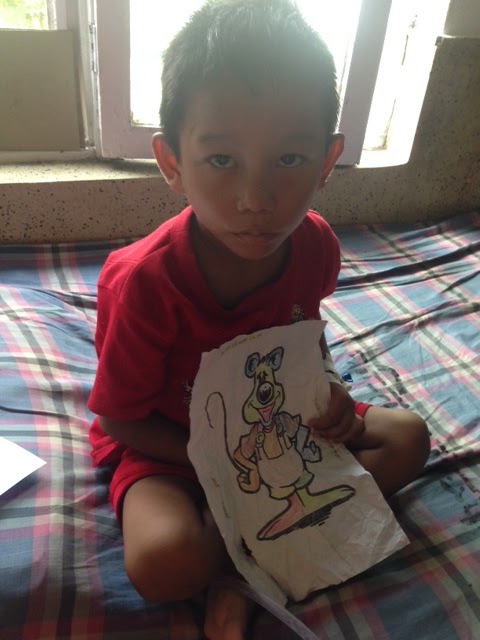
We purchased colored pencils in Kathmandu stationery shops, to help their economy.
I took some pages of a coloring book from here in Australia and had them photo copied many times. During many visits to the children's hospital we handed out small fluffy toys that I was given by the kind ladies at our local op-shop. We handed out the pencil sets and photocopied pages to each of the children. They loved showing me their beautifully colored pictures and got more pages to colour every time we returned to visit them.
The children have no toys or anything to occupy them during the long hours of every day, lying or sitting on their beds. The psychological benefit of something to do, I feel is almost as important as the medical treatment they receive.
Some of the children were so very sick and it was always very emotional to be there and talk with the parents and carers. I'm so grateful that I kept up with my Nepali language and didn't need an interpreter to assess who should receive financial help.


Kathmandu consists of a labyrinth of lanes with ancient buildings on either side. A miracle that more buildings didn't topple during the earthquakes in April 2015.


  It was not appropriate to photograph patients in the hospitals so this was a sneaky shot of the "Non- Paying Women's Ward" at Bir Hospital which cost each patient Rs 200 (Aud$3) per day. (Non-paying??)  The woman is Maihili Tamang who is suffering from heart & kidney disease and requires oxygen at all times. Their remote village was flattened during the earthquakes and they are living with their three small children under a tarp in a field with hundreds of others. They could not return to their village, or to their children, without oxygen and had no means to purchase any. We funded them for enough oxygen for the next few months until she needs to return to hospital for on-going fluid draining. A small thing we could do which meant she could have more time with her children during her short life.
In Australia her condition would be easily managed, maybe cured, but in Nepal her prognosis is grim and a long life is not possible for her.


      Leaving the hospital, taking a deep breath, don't cry. Don't cry! They must not see me crying.


Our accommodation in Kathmandu was in a family home a small distance from the City.
Every day some ladies walked with their cows as they grazed along the edges of the rice fields and lanes. I got to know this woman who had a lucrative business selling the milk from her cows to a line up of customers every morning and night at milking time. We had so much in common with our love of our cows.


These cows are completely safe from harm wherever they go. They don't appear to belong to anyone as they wander freely and sleep in the path of busy traffic. As Hindus the cow is an icon of worship.


Hard to believe we are in the twenty first century sometimes! 
Leprosy is still a big problem but is treatable. This man has been begging in this area ever since I first lived in Nepal in 1996. I used to take him bananas. This day I gave him money as I wasn't prepared to see him.
I am humbled by the support from so many people who have donated to assist in continuing this support to the very needy in Nepal.
To every one of you who donated money, or gave moral support, I thank you deeply for allowing me to confront the issues that I would not be able to afford otherwise.
I hope this brief outline has given you an idea of life in Nepal, and even though we can help in such a small way, it is definitely significant. To see an entire family break out of poverty over the past nineteen years is impetus enough, to keep going.
My humble thanks for supporting Jembella Farmgate stall, you donations and your kind words of support.


Related Posts Plugin for WordPress, Blogger...