Monday, 15 September 2014

Daisy takes a break (& so do we)

One of my most loved daily rituals has temporarily come to an end today.
I could have kept on milking Daisy for another few months, but her milk production has dropped off and Willow needs to be weaned off milk now that she's five months old.
A break in routine will allow us a few short holidays as well.
For the past week I've taken eight litres from her on alternate days in preparation for the drying off and she will now stop producing milk after a couple of days of swelling. I find this to be the most comfortable for the cow and I'll keep an eye on her, watching out for any signs of discomfort or mastitis.
Daisy gave birth to her first calf in October last year.  All of our cows are taught to foster other calves but she, being the highly strung little thing that she is, refused to accept another calf despite all of our efforts.
After trying all of our other methods of introducing a foster calf to a cow, Brian smeared onto the foster calf some of the placenta that we'd  frozen with this purpose in mind should the situation arise, with the intention that she would  lick the calf clean and then accept it.
Nothing we did would convince her to accept a new calf and so, after three weeks of trying we gave up.
Fortunately, Bella gave birth to Pumpkin a few days earlier and happily fostered the new little calf  (Lavender) that we had purchased from another dairy with the intention of giving it to Daisy.
When our cows are fresh in after calving, there is plenty of milk for their own calf, more than enough for household use (cheese making etc) and  sufficient for feeding another calf as well.
After the first four months, the calves can be weaned while another calf is brought in for raising. Generally, the cow's production will settle down to a steady amount and depending on the cow, if she has enough milk, another two calves can be raised. Or if for instance, I want to make lots of cheese every day, or feed orphan lambs, or grow pigs on milk, or if the cow's production has dropped I can raise just the one foster calf.
Another benefit of teaching cows to foster is being able to have small calves on your milking cow for a longer period of time. This gives us, the farmer, a bit more flexibility and freedom.
Of course the profitability of raising more calves has to be considered as well.
We can choose not to milk the cow on some days when we leave the calf or calves with the cow.  On the days that we want milk we separate the calf (calves) from the cow for up to 12 hours before we want to milk. This can be overnight if you want to do the milking in the morning, or separate the calves in the morning if evening milking is  your preference.
It's not a good idea to leave a calf of more than 5-6 months old suckling on a cow. The calf is getting very boisterous by this time and can damage the udder.
We also like to have more than one calf at a time so they have each other for company when separated from the cows. ALL animals will "do" better in company. They are happier, feed better, grow better and are generally healthier.
Daisy is due to have her next calf in April. Although, strictly speaking, we don't need to dry her off until two months before calving, we need to take a few short breaks away in the next couple of months before summer really hits.
Yes, even though we're living the dream, we too need holidays occasionally.
If she would comply to our wishes, and foster a calf, we could have put a new calf on her a month ago and retained our freedom to take holidays and have our milk as well.
She was initially inseminated on New Year's Day this year and, had all gone well, she should have calved in October (next month). However, things don't always go to plan and she slipped her calf at 3 or 4 months gestation. We had to start over again and call in the AI man once more.
Now that she's more experienced we're hopeful that she will accept foster calves next time around.  What a beautiful quiet milker she has become and we feel quietly proud to have trained her in the niceties of milking parlour manners and routine. Most credit to Brian who spends endless hours gaining the confidence of our new milkers, training them gently from when they are still small.
Her calf, Klaus, is booked in for the "on farm" butcher to visit next month as he will be a year old and perfect for the freezer.  The most nutritious and sustainable meat, straight from the paddock, no stress, no grain feeding (no irrigation, unsustainable farming practices and chemicals).
Grass Fed beef has finally found its place out there in the market place as more people realise the health benefits to the consumer and to the Planet.
                         .....................................................................................................

I recently read about growing new plants from the old plant. This is a new celery plant reborn from the celery crown that would otherwise be thrown to the chickens or sheep. I've since planted every celery crown I find and if I can deter the snails, they will grow beautifully.

I love to have a couple of celery plants growing so I can break off a few sticks from the growing plants as I want to use them, adding them to soups, stews or in a fresh vegetable juice.


Saturday, 13 September 2014

Making your own laundry detergent

Last year we removed the Hills Hoist & made this little kitchen garden in its place.
Brian built me another washing line that is more in keeping with the era of our 1911 built home.


The old cane wash basket & trolley purchased (cheaply) at a Garage Sale is just the icing on my wash line cake.

I started making our laundry detergent a couple of years ago. Not only do I save lots of dollars, I'm much happier about using the washing water on the garden.
In our dry state of South Australia we need to use all of our household water carefully and most people I know recycle some of their washing water onto their garden.
Like many people we used to bucket the water from the shower and washing machine, but realistically that isn't going to keep happening as we age and the buckets get too heavy for us.
So, one of the first things we did here when we started setting up the gardens was install a shut off valve on the water outlet pipe outside the house.
In our case the grey water from inside the house runs into a septic tank because we are outside the town drainage system.  It's still possible to install a shut off valve if you live within the town if your outside pipes are exposed above the ground.
Attaching a hose to this shut off valve we can divert the water from the bathroom and laundry onto various garden areas using gravity.
However, this water contains the residues of any detergents and substances used inside the house and can be detrimental to the soil and plants growing in it.  This is when I turned to making my own soaps and detergents.

                               Liquid Laundry Detergent
1 cup grated soap 
1/2 cup washing soda (Lectric Soda)
1/2 cup Borax
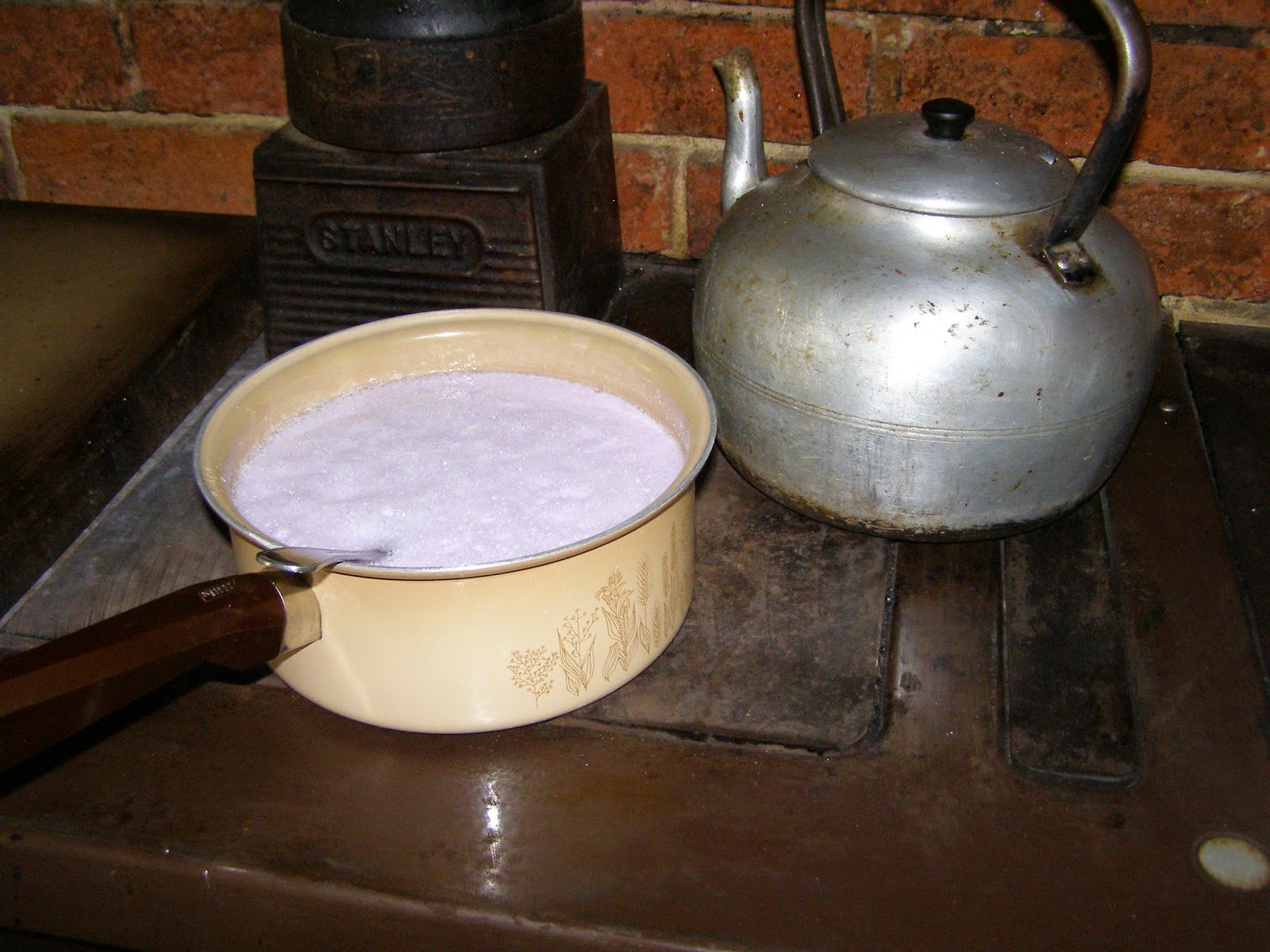
Melt in a stainless or enamel saucepan with 1.5 litres of water until dissolved .
Tip this mixture into a plastic bucket.
Add 8 litres of water & give it a stir.
Pour into large plastic bottles leaving a few centimetres at the top for shaking up when it gels.
2 litre vinegar bottles are perfect.
This will become quite a thick gel & needs shaking up to make it pourable.
Use approx 1/2 cup with each load of washing.
Suitable to use in both top or front loader machines.
It doesn't foam up but it gets the washing clean.

The recipe suggests either Lux Flakes or grated soap.  I use a cake of soap that I buy at the supermarket for a few dollars for a pack of five. Much cheaper than Lux and is just as effective. 
The easiest way of grating the soap is to get someone to grate it for you when they're sitting there having  cup of tea and watching you do all the work. 

Notice the space left empty in each bottle for easy shaking up of contents.

When using grey water on your garden it's best to alternate it with fresh water occasionally to avoid the salts building up in the soil. This gentle home made laundry detergent is much less toxic than the chemical laden commercial detergents. I've been watering our fruit trees and vegetable gardens with our grey water for years.

After a very wet winter we're not getting the Spring rains that we hoped for and the soil is drying out rapidly. The gravity fed grey watering system (a hose that I can move about) is trickling onto the vegetable gardens keeping things growing without costing us a cent in water bills. 

Brian has happily returned to work this week after seven weeks. His hip surgery was a great success and as we sat outside with our cups of tea this morning he explained his plans for redesigning the back garden. He's talking of building retaining walls and a pizza oven. Welcome back to the man I used to know Brian!!
The sun is shining and the garden beckons.
Thanks for dropping by and I hope you have a wonderfully productive weekend.


Sunday, 31 August 2014

First day of Spring

"Spring has sprung, the grass is ris. I wonder where the birdies is!"
Perhaps it was written by Ogden Nash, or was it an anonymous writer? Maybe we will never know.
Where ever it came from it pretty much sums up the first day of Spring.
Not the bit about the birds though. We're now woken by the whole gamut of "Spring" birds and the morning noises are a symphony.
When we first moved here eleven years ago the hungry cats from the dairy nearby kept all birds away, but our dogs have kept the cats away. Now there are birds aplenty.
To encourage birds to stay in our garden we planted lots of trees and we supply plenty of water for them.
Anyone can enjoy the company of birds by simply making water available in bird friendly containers. The containers don't need to be expensive or fashionable but the birds need to feel safe or they won't use them. Most importantly, don't forget to keep them topped up with water.
Once you start to encourage birds to your garden they will rely on you to continue. Another example of giving a little, and receiving lots of pleasure.
An old bowl with a rock in it, placed in an old pot nestled in the garden is a favorite with the Magpies, Grey Shrike Thrush, New Holland Honey-eaters, Willy Wagtails, Silver eyes, Blackbirds, Rosellas, Top-knot Pigeons, Murray Magpies, Finches and Wrens.
The Galahs, Corellas and Sulphur Crested Cockatoos prefer the troughs in the paddocks where they skylark and perform their comical shenanigans.
This one is at ground level but note the brick on the outside and the rock inside. For the Skinks & Blue Tongue lizards to climb in and out of. Blackbirds use it too.
The lizards, frogs, and probably snakes, love this as well as the birds. Dug into the ground with rocks inside and on the outside edges.
A proper bird bath sits under the apple tree where a pair of Willy Wagtails have nested every year for longer than I can remember.  (Garden art by Brian)
Birds in your garden will help keep pest bugs under control.
Some people are annoyed by Blackbirds but they do a wonderful job of finding earwigs and unwanted pests under the mulch and grubs on the plants, plus their morning and evening song is a delight.
If they flick out the mulch, all it takes is a quick flick with a leaf rake, or your foot, to tidy it again.
My dear friend Rachel who lives in a leafy suburb of Adelaide provides bird seed and water for the most glorious Rainbow Lorikeets. What a delight to sit eating breakfast while watching the show outside.
And speaking of Rachel, here is her Devilled Chicken Recipe that is one of our favorites and mentioned in an earlier post. Written by her on this paper at least fifteen years ago!

                                           Rachel's  Devilled Chicken
Take one free range organic chicken and cut it into pieces.
(Or use chicken pieces purchased from the supermarket if you don't have them running in your back yard.)
The recipe says it should be browned in butter or oil before adding the other ingredients, but I'm a cook always in a hurry and admit to skipping this part.
So this is how I do it.

In an ovenproof dish put chicken pieces,
1 sliced onion and garlic to taste.

Mix together in another bowl,
1 cup tomato sauce
1 dessertspoon brown sugar
Grated rind of 1 lemon and the juice
2 tablespoons apple cider vinegar (or plain vinegar)
1 heaped teaspoon mustard
1 heaped teaspoon curry powder ("Keens Traditional Curry Powder" is my favorite for this)
1 tablespoon soy sauce
1 teaspoon salt
1 cup of water
Pour over the chicken pieces.
Put the lid on and cook in moderate oven for approx 1 hour.
In my wood oven I cook it slowly for 2 hours.
It could also be cooked in a slow cooker.

Lazy cook tip;
Add chopped carrots, pumpkin or any vegetables on hand to make this a complete meal in one pot.

Serve with rice.
Freezes well.

Thanks for dropping by to catch up and I hope your Spring fills you with dreams and inspiration.


Friday, 29 August 2014

August at home

Most years we're away on our annual holiday for the month of August, but this year we've needed to be here. I think we need to look at re-scheduling our future holidays so that we're here to enjoy August at home in the Barossa Valley.
These flowering cherries along the front are quite stunning & we've never seen them at their best until now.
The Happy Wanderer (Hardenbergia Violacea) is slowly forming a hedge along the front fence & the purple blue colour is gorgeous.
Last year I planted a couple of Cootamundra Wattles (Acacia Baileyana) near the fence which have flowered this year & add bright yellow to the colour scheme.
Over the years I've grown many different plants here but with our dry hot summers & the cost of water, it just doesn't make sense to grow anything that isn't drought tolerant.
Brian's hip replacement surgery was just fours weeks ago but look at him now. His recovery has been excellent & although he's still not allowed to drive or return to work for another couple of weeks he's been gradually improving every day.
Today he sprayed the stone fruit trees with Copper Oxychloride. Sprayed at bud swell stage for preventing Leaf Curl & freckled fruit. He will keep an eye on the trees as they come into leaf over the next few weeks & spray again later if any leaves show signs of curling.
While I've been caring for Brian & doing the tasks around the farm I've reduced my working days to two days each week. The days I go to work start very early with milking Daisy in the dark, feeding the cows & letting the chooks out of their shed before 7am. Almost every morning has been frosty as I crunch through the icy grass across to the dairy with my hands in pockets. Invigorating!
I'm definitely a winter person.
It's been a lovely experience to care for the person I love. I've enjoyed every bit of it & has once again reinforced my appreciation of just how much work he does around here. This farm & our lifestyle is definitely a two person show.
My success at managing all of the animals has been quite empowering & a boost to my confidence, but I'm happy to hand over the chook management to Brian once again.
Three weeks ago I decided to let a broody hen sit on some eggs so I gathered a dozen & settled them under her. To prevent the other hens from squeezing in & laying their eggs in the broody hen's nest I placed a wire crate in front of the nest. Water container was kept full & some wheat made available to the hen. I wrote the date on the calendar & the expected date of hatching 21 days later.  Exciting!
She was only a week away from the due time of hatching when I noticed she was off the nest & looking like she wanted to get out of the crate. I let her out thinking she would return after a quick run around, but she didn't, & after a few hours the eggs were cold. She wasn't interested in sitting on them again. Oh dear, what went wrong? What a disappointment. Yes, I admit I wasn't looking forward to breaking the eggs & finding chicks in there so, I when Brian offered I gladly accepted. They were all empty!
The rooster was obviously infertile so into the freezer he went that very same day. Soup will be on the menu soon.
Two days later & Brian has purchased a couple of lovely (and lively) roosters from a breeder friend. Double the crowing at 4am! Thankfully we don't have neighbors living close to us.


 Life for us is returning to normal & how grateful we are for that.

Saturday, 16 August 2014

Like a Virgin (Olive Oil)

We swapped this beautiful fresh olive oil for a dozen eggs. !!
Our friends and distant neighbors, Danielle and Brett with their boys Oscar and Cooper, called in again last week for some fertile eggs for hatching in their new incubator.
Their first attempt had disappointing results and Brett felt he'd failed, but we reassured them that it takes quite a few attempts with incubating before successful results can be expected. Each incubator is unique and takes time to work it all out. This is when we all realize that mother nature is clever in more ways than we ever could imagine. The mother hen knows exactly when to provide the right conditions of warmth, humidity and rotating for the eggs to hatch, so when we try to emulate that process we need to have our incubator performing to the exact requirements needed.
Brett and Danielle will eventually succeed with hatching out eggs and when they do they will appreciate another aspect of how rewarding, albeit fragile, this "Good Life" can be.
This olive oil from their trees grown on their own land is superb and we feel so privileged to receive such a gift.
It's important for us older folks to  pass on the knowledge to the younger ones who are interested and want to learn so we love it when they ask questions. They're our future.

As if the poor bees aren't in enough serious trouble!  (Warning.... Rant follows!!)
Every thinking person who lives above the ground is aware that declining bee numbers is reaching catastrophic proportions.  Our entire future of food depends on bees for pollinating food crops and trees.  The increasing use of pesticides, diseases and mites found world wide are causing colony collapse which we all need to be taking very seriously.
This week we received from PIRSA  (Primary Industries and Resources SA) notification  that a new pesticide has been released to save the Canola crops from damage by the Beet Western Yellow Virus (BWYV) and Diamond Back Moth (DBM).
We are warned that this pesticide will KILL BEES.  So we should make sure our bees are not within range of any Canola crops.
It confounds me that in order to save ONE crop (Canola) Australia will now suffer even greater risk of losing EVERY crop of anything edible.
We have Canola crops dotted in all directions around us which is within the 3 km flight range of our bees. What can we do? Nothing!
Please excuse the use of capitals, but yes I AM shouting as I write this. It's shout worthy stuff.
I wonder if Monsanto are behind this as well as all their other devastating horrors world wide.
Having recently watched Food Inc I would urge all people who eat food to watch it. I borrowed a copy from our local library, but it's available for viewing on line if you type it into your search engine.
Rant over and taking some deep breaths, I can show you the newest addition to my kitchen.

Now we can grind our grains as we need them with our Grain grinder for our sour dough breads, healthful & nutritious biscuits, cakes etc.

                                    Nutritious & sugar free whole wheat & oatmeal biscuits.

1 & 1/2 cups oatmeal
1/2 cup whole wheat flour
1/2 cup dessicated coconut
2 teaspoons sesame seeds
3 teaspoons LSA   (ground linseed, sunflower, almond)* optional
2 dessertspoons organic coconut oil
1 large dessertspoon honey
1 egg

Put dry ingredients in a mixing bowl.
Melt the coconut oil & honey gently in a saucepan before adding to dry ingredients.
Mix well & add the egg.
Mix well, shape into balls, place on oven tray lined with baking paper & slightly flatten with your hand. They will not spread because there's no rising agent.

Bake in mod oven for approx 20 mins or until browned slightly.


Saturday, 9 August 2014

Simple living

Occasionally we host group tours here on our little farm. It all started a few years ago when we received a phone call from the Deaf Society in Adelaide. They were planning their monthly bus trip outing, had heard that we sold honey direct from the farm & wanted to call in for a look at what we've got here.  I really didn't think we had much to show them, but welcomed them anyway. They asked to have morning tea here, so that was a start. We had a month to prepare so we gathered our thoughts & made a plan.
Finally the day came & we waited nervously for their arrival. All forty six of them. The morning tea trestle tables set up on the verandah were stacked with home made goodies, the urn was boiling, the coffee plungers were ready & some chairs were placed around.  What a sight it was to see the huge bus pull up outside our gate. Rather overwhelming. What had we done?
First they had a cuppa & something to eat. I made shortbread from my home made butter from our house cow which was a talking point, & also some Anzac biscuits. A simple morning tea that was much appreciated as it was all made from scratch. Tea was made in tea pots & coffee made in plungers.
Our old milk separator is permanently set up on the verandah so we separated a bucket of that morning's milk to demonstrate the workings of this ingenious contraption. Extracting the cream from the milk was a huge hit.
From there we started walking around the farm & talked about grafting of fruit trees, the keeping of pigs, the smoking of bacon, hams & sausages, & the management of fowls for meat & eggs. Across the paddock to the shearing shed where we had a couple of sheep & two alpacas penned for close inspection, into the dairy & milking parlour where they could see the workings there although we didn't do a milking demonstration. As I've mentioned in previous blogs, our cows aren't very sociable with strangers & it could have been dangerous.
Then we went on to the honey shed to show the equipment we use for extracting the honey. Once again, there was no actual demonstration for safety purposes.
There were jars of honey for purchase & plenty of my home made jams on sale as well which sold like hot cakes.
The bus driver started tooting the horn of the bus & it was time for them to depart.  They had spent just over two hours here & all agreed that it wasn't enough time.
The cost to the group back then was $5 per head. After taking out our expenses for the tea & coffee we put all the money from the morning tea in an envelope & donated it back to them. The Deaf Society was a worthy cause to support with the profits.
Since then we've hosted many gardening groups & various clubs using the same formula.   The proceeds are used for our charity work in Nepal.
If we hadn't been prompted we would never have thought we had enough  to interest visitors, but the opposite proved to be true & we have raised quite a lot of money for assisting families in Nepal.
So I would urge others to think outside the square. Maybe you also have something to share with interested visitors whether for raising money for charity or for supplementing your income.
I wrote up an information sheet for visitors to take away with them which I'll share with you here.
                                   Willing participants at our latest Bio-dynamic workshop.

Welcome to our little patch.
Purchased in 2004 & with the house in a derelict state we set out our three main priorities.
1- Remove ugly dead pine trees at the front & replant a screen of trees.
2- Establish a vegetable garden.
3- Erect some basic fencing so we could raise some sheep & hens for our own meat & eggs.
All other additions, dairy, shearing shed, stock yards, sheds etc have evolved in the following years as time & money permitted.
After those priorities were in place we started renovating the house to make it comfortable & energy efficient while retaining the size & character of the old place.
Solar panels were installed & as we are frugal with our use of electrical gadgets they produce more power than we use, thus receiving a yearly cheque from our supplier.
A wood burning heater in the living area warms the house & wood burning kitchen stove for cooking & warmth almost year round. When the temp goes above 25degrees we use the gas stove.

The house was built in 1911 from stone, has high thermal mass & with wise management we enjoy comfortable temperatures year round.
Heating with wood from sustainable sources during winter keeps us warm & closing the doors & windows during hot summer days keeps us cool. Ceiling fans, canvas outdoor blinds, wide verandahs, & deciduous plantings add to our comfort. Air conditioning was installed but is rarely needed.
Rain water tanks capacity of 120,000litres provides all our needs for the house, garden & stock water troughs.
Grey water from the laundry & bathroom gravity feeds to water our fruit trees & vegetable gardens.
We make our own soaps, shampoos, laundry detergent, skin lotions & deodorant using no chemicals.
Growing most of our fruits & vegetables organically & making everything from scratch, no fast foods or convenience processed foods.
All our meat is grown here on the property to our ethical, humane standards & organic practices. Most of the meat is butchered on farm to reduce stress on the animals & improve the eating quality.
Two milking cows provide all of our dairy needs year round - milk, yoghurt, cheese, butter, cream, icecream.
Baby pigs are purchased in Sept each year, fed on milk & scraps, & slaughtered in February.

Sheep & cattle for meat & a small income from Merino wool.
Fowls for eggs & meat. Bees for honey & pollinating the garden & orchard.
Fruit trees for jams, preserves & fresh fruit. Animal manures feed the methane digester to provide enough gas for running the barbeque a couple times a week during summer.
We prefer to use herbs, vitamins & organic foods instead of medicines & chemicals for ourselves & animals.
Paddock management, stock rotation, & access to beneficial herbs keeps parasites & worm burdens under control.
Composted animal manure, liquid fertilisers & bio-dynamic preparations are all made on farm & used throughout. Bio-char & bone-char made in Brian's home built burner for feeding the gardens & paddocks.
A contractor cuts & bales our hay & we cut our own chaff.
Our gardens reflect the way we live & the plants we grow need to survive the challenges we face here; pests (earwigs & millepedes), hot dry summers & severe frosts to name a few. Weeds have their place & we've learned to be a bit more relaxed about them. In the wetter months we enjoy the lushness & colour but accept the dryer times for what they are & don't water excessively. Seasons!
All proceeds from Farm Tours & Jam sales are used for our Nepal Family Assistance Projects.
"Living simply so that others may simply live"
Tours with morning or afternoon tea are available year round.
Bookings required.  Min 5 people.


I've been watching the stats for this blog & today have reached 1,302 page views from places as far flung as UK, USA, Ukraine, Finland, Poland, Germany, NZ, Russia & France.
This seems unfathomable to this self confessed, tech challenged amateur.  So, if you've happened along to find this blog I'd really love to know where you are & how you found the blog. I'm quite certain other readers would enjoy your feedback, as would I.  Even better if you could share some of your experiences as the way we do things here on our farm isn't the only way & doesn't suit everyone. Maybe we could all learn a better or easier way to get the task done.


Saturday, 2 August 2014

Kale Chips for Milk

We are so fortunate to have a wonderful community of friends here in Angaston.  Whenever I have some of Daisy's milk to spare I give some to my like minded friends who really appreciate the value of raw milk. Raw milk from grass fed cows is very different from conventional milk, is non acid forming in the gut and has many more health benefits. Many people who can't tolerate dairy or fresh cow's milk find they can drink raw milk but, it must be from grass fed cows. Feeding grain to cows completely changes the molecular structure of the milk because cows were never meant to be grain eaters. Their gut wasn't made for digesting grain, but that's another argument for another day.
If you want more information about grass feeding cows the natural way I'd recommend reading some of Joel Salatin's books. In particular "Folks This Ain't Normal" & "Salad Bar Beef". I'm a huge fan of Mr Salatin and love his articulate way of speaking and writing about food and the way it should be produced.
Yesterday I took some milk to my friend Meg who lives just up the road and she gave me a huge bag of kale freshly picked from her garden.
I just love this trading that goes on all around us.
We had kale in our smoothies this morning. Later today we'll have a fresh juice made from carrot, beetroot, kale & an apple.  There are still three jugs of kale in water to keep it fresh as long as possible, so I made some KALE CHIPS the way my daughter Lizzie taught me.
If you're like us and you've given up eating all processed foods (& foods with numbers), you will love Kale Chips.
To make chips takes about 5 minutes to prepare and approx five minutes to cook in a moderate oven.
Step 1- Tear the greens away from the stalks and place chip sized shapes on a baking sheet. (Keep the stalks for using later in your fresh juice or for adding to soups or casseroles.)
Step 2- Brush each piece with some softened Organic Coconut Oil
Step 3- Sprinkle with Sea salt or Himalayan Pink salt (We use only Himalayan Pink salt)
Step 4- Cook for approx five minutes in a pre-heated oven.
Keep an eye on them because they tend not to cook evenly. Remove the cooked chips until all are done. It's hard to resist putting them straight into your mouth, they're so delicious, salty and totally nourishing.
                                                                     Kale Chips


Related Posts Plugin for WordPress, Blogger...